
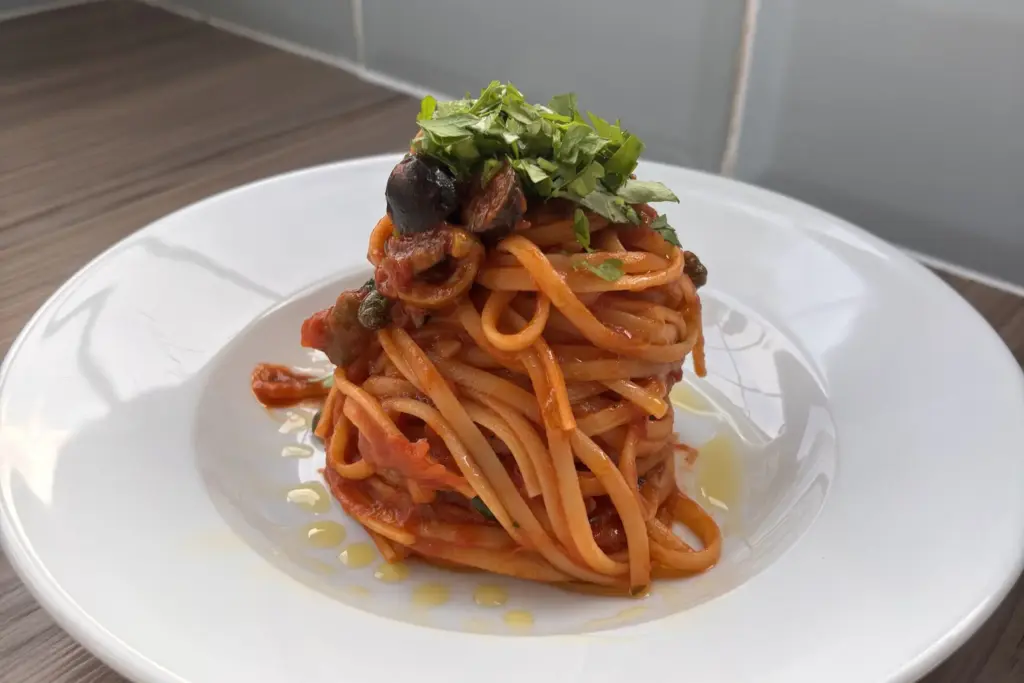
The story behind puttanesca
The name means what you think it means. Puttanesca translates, politely, as “in the style of the w****.” Nobody fully agrees on where it came from — the most romantic theory is that it was cooked quickly between clients in the brothels of Naples, the most boring theory is that someone just called it “that rubbish dish” (puttanata) once and it stuck. Either way, Naples owns it and is entirely unbothered by the conversation.
What actually matters
What matters more than the name is what it is: a dish built entirely from a Mediterranean storecupboard. Olives, capers, anchovies, tinned tomatoes, garlic, chilli, olive oil. Nothing that needs a specialist shop, nothing that goes off, nothing that requires more than twenty minutes of your time. It is the anti-recipe recipe — the thing you make when there’s nothing in the fridge and it turns out to be better than most things you planned in advance.
About those anchovies…
The anchovy is the argument people have before they make it and never have again after. It doesn’t taste of anchovy. It dissolves into the oil within two minutes, disappears completely, and becomes the invisible backbone that makes everything else taste more like itself. If you think you don’t like anchovies, make this and then reconsider your entire position.
One rule
One rule, non-negotiable, enforced in Naples with genuine hostility: no cheese. Parmesan on puttanesca is not a preference, it is an error.