
Bolognese

4 hours 30 minutes
Easy
Serves 4
The real one. Slow, rich, and nowhere near as much tomato as you’d think. Four hours well spent.
Bolognese

The ragù everyone thinks they know

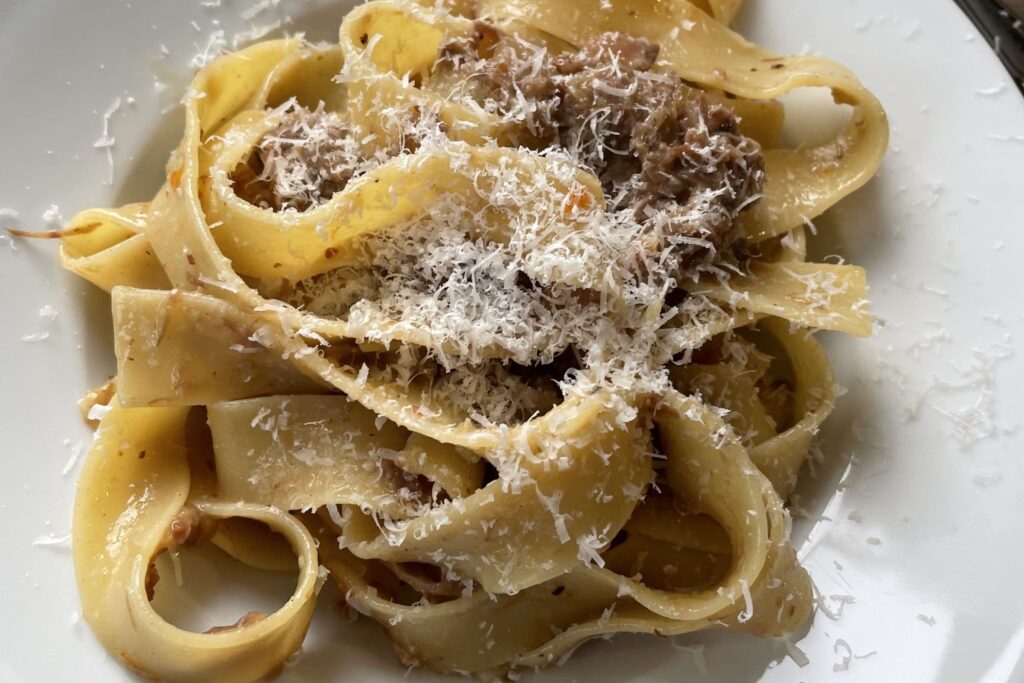
Bolognese usually gets served up outside Italy as a thick tomato sauce with mince stirred through, and that’s fine, it’s still tasty. But the actual dish, ragù alla Bolognese, is a bit different. It’s a meat sauce more than anything, the tomato’s just there in the background. It takes about four hours, it goes on wide pasta like pappardelle or tagliatelle rather than spaghetti, and it’s got milk in it, which tends to surprise people the first time round.

If your only reference point is a jar of tomato sauce with eight tins worth of extra veg thrown in, peppers, sweetcorn, peas, the works, then this is going to feel like a different meal entirely. No judgement, that version’s a Tuesday night classic in its own right. This one’s just a different thing.

There’s an official version of the recipe that was written down and deposited with the Chamber of Commerce in Bologna back in 1982. A proper notarised recipe for a pasta sauce. Once you’ve made it a couple of times you’ll get why they bothered.

Give the soffritto its time

Onion, celery and carrot cooked down nice and slow until soft and sweet is the base the whole thing rests on. I go a bit heavier on the onion than the carrot here, it adds a nice sweetness, though there’s no harm doing it even if you’d rather. Worth giving it the full 15-20 minutes rather than rushing through. Wiping the pan out before the meat goes in is a small step that helps, any bits left behind from the veg can turn bitter on a high heat.

The meat is worth getting right

Mince with a bit of fat in it, around 20%, works best here since that’s where most of the flavour comes from and it keeps things tender through the long cook. Beef and pork together is a really good combo. Veal’s traditionally the third meat if you can get it, but beef and pork on their own make something genuinely great.

Getting proper colour on the meat matters more than you’d think. High heat, leave it a minute before stirring so it can actually brown, season it well. That’s where a lot of the depth comes from later.

Why the milk?

It goes in twice, a splash early on to help tenderise the meat, and another right at the end to bring it all together. That last bit softens any sharpness from the wine and tomato, helps the fat feel part of the sauce rather than floating on top, and gives it that warm rounded colour a good Bolognese should have. Whole milk, not skimmed, and don’t skip it.

Save some for later

This makes a decent batch, so it’s worth doing a bit extra if you can manage it. A portion of this in the freezer means a proper homemade lasagne is basically already sorted for a night when you really can’t be bothered cooking from scratch. Future you will be genuinely pleased about it.

The pasta bit

Pappardelle or tagliatelle, something wide enough to actually hold the sauce properly. But honestly, any pasta you think works, probably works. A short pasta like rigatoni works great for this. Just no spag for this bol please…

Finishing it with a splash of pasta water and a bit of butter before ladling the ragù in makes a real difference, gives you something that tastes finished rather than just pasta with sauce on top. Get the pasta properly al dente since it’ll cook a touch more in the pan. Go generous on the Parmigiano.

Method

1
Render the pancetta
Chuck the pancetta into a cold pan and put it on medium heat. Let it slowly give up its fat and start to colour a bit. Everything else builds on this, so don't rush it.
2
Cook the soffritto
Add the onion, celery and carrot to the pancetta fat with a splash more olive oil, season it, and cook gently until it's all soft, sweet and the water's cooked away. About 15-20 minutes. Scoop it all out and set aside, then give the pan a wipe with kitchen roll so nothing burnt hangs around for the next bit.
3
Brown the meat
Get the pan properly hot on a high heat, add a splash of oil, then the mince. Leave it alone for a minute or two rather than poking it straight away, you want real colour and some good stuff stuck to the bottom of the pan. Season it well. Once it's frying loudly and smelling great, you're there.
4
Deglaze and add the tomato
Pour in the white wine and scrape up everything from the bottom of the pan. Let it bubble down until it's mostly gone, then stir through the tomato puree and let it cook out for a couple of minutes. Don't go overboard on the puree, this is more of a meat sauce than a tomato one.
5
Bring it together
Tip the veg and pancetta back in, stir it all up, add a splash of milk, then pour in the stock, roughly enough to just cover everything. Don't worry about being precise here, it'll reduce right down over the next few hours anyway. Just go easy on how salty your stock is and taste as you go. Drop in the bay leaves, bring it to a gentle simmer, then turn it down as low as it'll go.
6
Cook low and slow
Let it tick along for at least 4 hours, stirring now and again and tasting for seasoning as you go. It should barely be bubbling. Top up with a bit of water or stock if it looks like it's drying out. After 4 hours it should be dark, rich and glossy. Fish the bay leaves out.
7
Finish with milk
Stir in one more splash of whole milk before serving. It softens everything out, takes the edge off the wine and tomato, and gives the sauce a lovely warm colour and a silky finish. Give it another 5 minutes on the heat, and taste one more time.
8
Cook and finish the pasta
Cook the pasta in well-salted water until properly al dente, a couple of minutes under what the packet says. In a wide pan melt the butter with a ladle of pasta water, add the drained pasta, then ladle in the ragù bit by bit until it looks right. Toss it together, take it off the heat, and finish with a generous amount of Parmigiano. Serve straight away.

Drinks pairing

Any decent Italian red does the job, Montepulciano d’Abruzzo is about £8 in most supermarkets and works a treat. A cold lager’s honestly just as good with this.

Ingredients

Serves 4
150 gpancetta, diced.
1 Wholelarge onion, finely diced
2 Wholecelery stalks, finely diced
1 Wholemedium carrot, peeled and finely diced
2 tbspolive oil
300 gbeef mince, 20% fat
300 gpork mince
150 mldry white wine
2 tbsptomato puree
200 mlwhole milk
500 mlbeef or chicken stock, plus more as needed
2 Wholebay leaves
200 gtagliatelle or pappardelle
50 gbutter
1 Handfulparmigiano Reggiano
Tools needed
Large cast iron pan or heavy-based pot, wooden spoon, kitchen paper, ladle, large pasta pot, wide pan for finishing

Made this dish?

Show us your plate. Tag us on Instagram and we’ll share our favourites every month.